Tech Talk: Evaporators and Crystallizers heat up the semiconductor ZLD market
Share this insight
With regulatory discharge limits tightening and rising water risk, the semiconductor industry is increasingly turning to zero liquid discharge (ZLD) solutions. Evaporators and crystallizers play an essential role in these ZLD systems, and despite a variety of membrane-based concentration approaches entering the market, it seems that the tried-and-true thermal technologies are here to stay. Appetite for thermal brine concentration and crystallization technologies is growing, and creative implementation strategies are taking the foreground.
Industry aims for zero
What once held semiconductor manufacturers back from ZLD - the high capital costs and energy requirements of thermal technologies - has been superseded by the urgent industry-wide need for better water risk management and site self-sufficiency. The industry is quickly trending towards more water recycle and reclaim. Water reclaim leads to more concentrated waste streams which often need MLD or ZLD to manage.
Bruce Bishkin, senior process engineer for water technologies at Veolia, noted the advantages ZLD offers for a semiconductor manufacturer: “reducing long term costs in a) wastewater disposal fees and surcharges, b) reduced freshwater withdrawal, and c) recovery of valuable materials like acids and chemicals from waste.”
Implementation of MLD and ZLD can be a key lever for securing site self-sufficiency and speeding up fab construction. Steven Lam, head of technology at Gradiant, commented that “interestingly, we’re seeing instances where facilities have negotiated that they will implement ZLD to secure operating permits even where ZLD is not yet mandated. It is a very good bargaining chip.”
A century-old technology, a modern market
Thermal evaporators and crystallizers have been industrial mainstays for over a century. As a percentage of the water treatment market, semiconductor demand for thermal technologies is modest compared to mining and desalination, but demand is growing rapidly. As Lam puts it, “evaporators and crystallizers are the workhorse for the ZLD scheme in a semiconductor fab.”
In the US, the market for evaporators and crystallizers for ZLD (particularly for semiconductor) is now surging, not just for regulatory reasons but also as a strategic tool to accelerate fab construction and secure social licence to operate. Europe’s adoption has been slower. Although sustainability regulations are typically strong drivers for Europe, lower water risk and a smaller proportion of advanced manufacturing in Europe means ZLD has yet to make a mark on this market, and is unlikely to do so.
Globally, the market for ZLD is stronger in regions with stringent discharge regulations and limited freshwater availability. India’s mandate for ZLD for all industrial wastewater has made it a huge market for evaporators and crystallizers, though the country’s front-end semiconductor manufacturing is nascent, while China leads in manufacturing evaporation and crystallization equipment.
Thermal evaporator/crystallizer technology suppliers with semiconductor industry installations
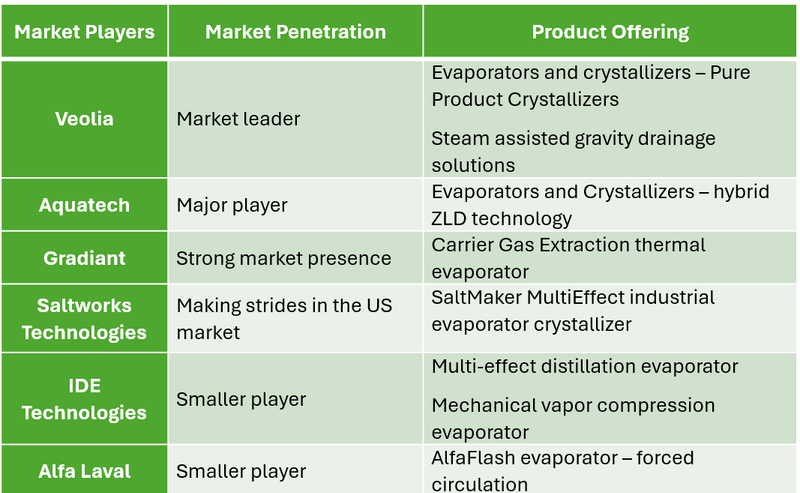
Third-party integration is the norm for these technologies, as most suppliers act as integrators for semiconductor manufacturers. With critical uptime at stake, end-users are prioritizing experience over ingenuity when it comes to ZLD treatment trains. There is potentially room therefore for companies to leverage decades of operating and design experience to enter the semiconductor ZLD market, such as newcomer Fathom.
A saturated technology market
The most common evaporation technology featured in semiconductor wastewater treatment is the vertical tube falling film evaporator (VTFF). Mechanical vapor compression (MVC) drives the evaporator, using pressure to reduce the electricity needed for steam generation, making it more space and energy efficient than steam-driven systems. This VTFF configuration has a high evaporation capacity relative to the size or cost of the unit, operates efficiently even with low temperature differentials, and is less prone to scaling than alternatives such as rising film evaporators. For this reason, VTFF evaporators are generally the preferred configuration for industrial wastewater minimum and zero liquid discharge.
Niche thermal technologies competing with evaporators, such as membrane distillation and humidification-dehumidification, have not managed to leave a lasting impression. Years of operating experience with evaporators and crystallizers mean that integrators have technology selection down to a fine art. Nathan Haralson, founder and CEO of Fathom expressed his skepticism towards alternatives on the market. “There’s nothing new under the sun when it comes to thermal evaporation and crystallization,” he said, “Sometimes the simplest option is the best option.” Supposedly 'new' design choices pitched by some suppliers, he noted, such as switching from shell-and-tube to plate-and-frame heat exchangers, have often already proved inefficient in practice for wastewater ZLD applications.
Crystallizers are forced-circulation evaporators which push beyond solubility limits to further concentrate and precipitate remaining solutes. While there are some technologies emerging as competition for thermal evaporators, thermal crystallizers have no equal on the market, and are an inescapable necessity for those pursuing zero or near-zero liquid discharge.
There are some opportunities for non-thermal solutions to disrupt the market for brine concentration steps in a MLD or ZLD system. High recovery RO, membrane distillation and forward osmosis are alternatives to thermal evaporators which could save energy and maximize water reuse. Non-thermal brine concentration solutions could reduce the required size and cost of an evaporator or crystallizer.
However, these methods of brine concentration have their downsides – a more concentrated brine stream increases the rate at which a crystallizer scales, harming uptime and increasing operational complexity. “It’s hard to manage the mixed salts that precipitate at higher concentrations,” said Lam, “these double salts have lower solubility points and are hard to control in a membrane system, and much easier to manage in a thermal system.”
For wastewater brine concentration, thermal concentration technologies maintain an edge of durability over membrane tech. “Membranes are highly sensitive to changes in water chemistry, whereas in contrast, thermal systems can tolerate a much wider range of feed conditions, making them indispensable for sites where water quality fluctuates or where complex brines are involved,” explained Dan Bjorklund, director of industrial concentration at Aquatech.
Smart design offers operational efficiency
Reducing maintenance is a key challenge with evaporators and crystallizers in a semiconductor fab’s ZLD treatment train. Smart construction could offer opportunities to safeguard reliability and efficiency for evaporators and crystallizers.
While radical innovations for thermal tech are unlikely to make their debut any time soon in the ever-risk-averse semiconductor industry, Ben Sparrow, CEO of Saltworks Technologies, pointed out that innovative operation could extend uptime and reduce scaling. Saltworks’ forced circulation crystallizer operates at high shear and at an aggressive velocity to take early corrective action at signs of scaling – “when you’re flowing at high shear and high speed it’s more challenging for the scale to adhere to the heat transfer surface.”
Nuanced design of the treatment train around the evaporator or crystallizer (e.g. piping and pumps) is a way to get an advantage in a market where trusted technology is currently winning out over radical innovation; high flow rates and low head axial flow pumps can stave off scaling. Technology integrators advise careful selection of heat exchanger technologies to stretch maintenance timelines. For example, shell and tube heat exchangers are favored because their tube diameter allows scaling to build up without blocking flow entirely.
Creative strategies for building redundancy for thermal systems can avoid costly downtime in operations without breaking the bank in capital outlay. Some innovations in the sequence and quantity of unit operations for evaporator and crystallizers in standby ZLD trains have potential to lower CAPEX. Maintaining a standby crystallizer instead of the standard redundant train can save capital costs.
Upstream treatment is paramount
With targeted 100% system uptime, unexpected chemistries in wastewater threaten operational efficiencies. Bishkin noted that “deviations in specified chemical composition of the feed must be avoided where possible” in order to maintain the integrity and efficiency of equipment.
Mixed salts are a key concern for semiconductor evaporators and crystallizers – unlike in other applications, fluctuations in feed quality can have unexpected results. Wing Cho, principal process engineer at Fathom, noted that feed quality can affect temperature which can also complicate operations. “Temperature increases can change salt crystal morphology over time, which has repercussions for equipment, as sharper solids grip easier to surfaces and make scaling more likely,” he said. Acidic salts in semiconductor wastewater such as magnesium chloride and calcium chloride are hard to precipitate and can alter pH or even damage equipment. Specialized alloys are required for corrosion control.
Standardizing trains – modularization wins
Procurement for thermal evaporators and crystallizers is increasingly becoming modularized. Nate Haralson noted that “the era of field erecting these kinds of systems has long been over.”
Modular units offer savings on CAPEX, procurement timelines, and footprint. Bjorklund agreed that modularization is the future for evaporators and crystallizers within semiconductor systems for ZLD. “Over the next five years, expect the market to shift more towards standardized and modular ZLD architectures, supported by stronger digital operations and tighter integration between reclaim systems and ZLD.”
A source at a leading architecture and engineering company told UltraFacility: “Hopefully within the next decade we can get to the point of fully automating these thermal systems – system complexity requires extensive operator training. It’s the Wild West of bringing industrial, heavy-duty systems into semiconductor, where reliability and finesse are the priorities.”
Thermal technologies demand innovative design
While appetite for ZLD in the semiconductor industry grows, tech innovation will take the backseat to validated technologies paired with innovative system design. Opportunities remain for supplementary solutions that could optimize cleaning and maintenance timelines, and the popularity of VTFF evaporators may come under threat from membrane-based alternatives, but thermal treatment remains an integral part of ZLD schema for this industry. The technology landscape for crystallizers is particularly static, and these are non-negotiable for ZLD, which is becoming a critical part of infrastructure for fabs seeking resilience and sustainability.
Ben Sparrow summarized it best – “it’s a fantastic market and a challenging space to play in, but ZLD and crystallizer technology is not for the faint of heart”.
Share this insight

Collaborators

Steven Lam
Head of Technology
Gradiant

Nathan Haralson
Founder & CEO
Fathom Water Corporation

Wing Cho
Fathom
Ben Sparrow
Chief Executive Officer
Saltworks Technologies Inc
Bruce Bishkin
Daniel Bjorklund
Organizations
Veolia
Aquatech
Gradiant
Fathom Water