Semiconductor in numbers: Is water reuse keeping pace with semiconductor growth?
Share this insight
This chart shows withdrawal and reuse for some of the largest chip makers, and year on year change from 2024-2025.
As production expands to meet demand from AI and advanced computing, companies are recycling more, reducing water intensity and investing in replenishment. Even so, withdrawals increased at most of the companies with comparable data.
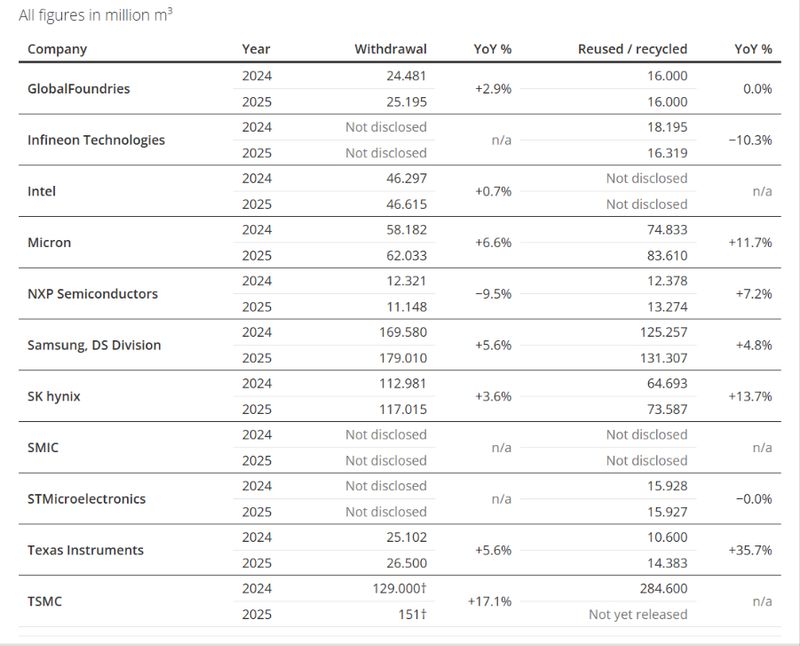
* Calculated figure rather than separately disclosed.
† TSMC reports 129 million m³ as total water usage, covering city water and externally supplied reclaimed water. It is shown in the withdrawal column as total incoming external water.
Definitions: definitions vary by company. Withdrawal may include municipal, surface, groundwater and externally supplied reclaimed water. Internal recycled water is excluded to avoid double counting.
The industry is trying to make fabs more water-efficient while building more of them and that tension is reshaping corporate targets. Earlier commitments focused on litres per wafer, recycling rates or annual conservation projects. Newer goals are more concerned with absolute outcomes: holding withdrawals flat during expansion, delivering cumulative savings and returning water to stressed basins.
TSMC has made the shift explicit. Its 2025 annual report stated that global expansion and the ramp-up of new fabs were affecting water intensity per unit of product, prompting it to make a global water-positive achievement rate its core measure.
The change reflects the difficulty of reducing water demand during rapid expansion. TSMC is trying to meet more of its growing requirement through recycled and reclaimed water rather than additional municipal supply. It circulated 284.6 million m³ internally in 2024. Even so, its intake of city and externally reclaimed water increased from 129 million m³ in 2024 to 151 million m³ in 2025. Without those internal loops, the external intake required to operate at the same scale would be even higher.
TSMC’s strategy is therefore not simply to use less water. As production expands, it is seeking to limit the increase in external demand by combining internal reuse with reclaimed supply, then using replenishment to address the remaining impact on local water resources.
This effort is tied to the rapid expansion of the physical infrastructure behind AI. Rising demand can create a direct operational risk in water-stressed regions, but social licence is also becoming more important. Data centres have already faced scrutiny over pressure on local supplies. Chipmakers may be less visible, but as capacity expands they will face similar questions about whether their growth is compatible with the needs of surrounding communities.
The move towards water-positive strategies reflects both pressures: companies need to secure enough water to operate while also demonstrating that expansion will not leave local communities worse off.
Samsung’s commitment shows how difficult that balance will be. The company aims to hold withdrawals at its five Korean manufacturing sites at 2021 levels through 2030, requiring it to expand without taking more water from the surrounding system.
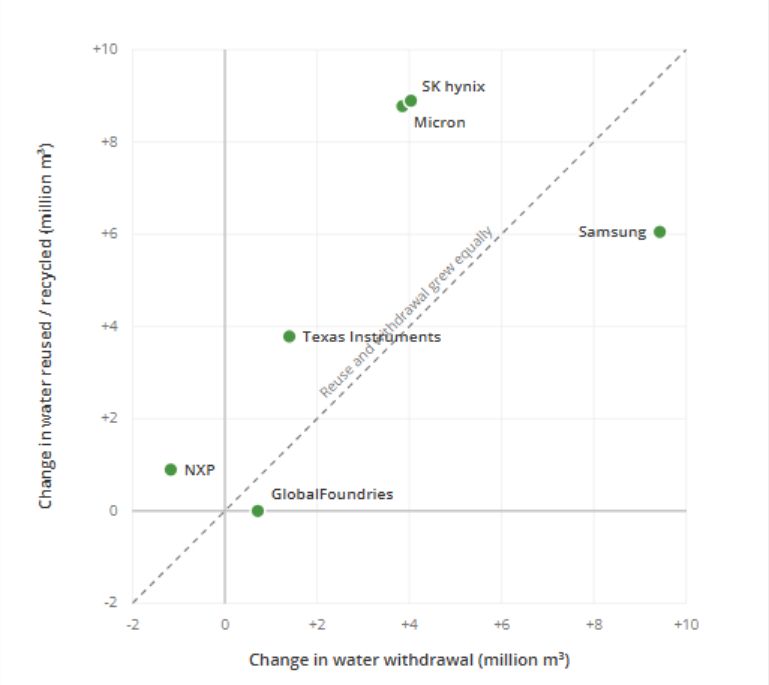
In 2025, reuse increased, but withdrawal rose faster and the reported reuse rate slipped. The data does not suggest Samsung has stopped improving reuse; it shows that manufacturing growth is absorbing those gains.
For water technology suppliers, that creates an opening. As fabs grow, reuse capacity will need to increase through higher recovery, treatment of more difficult streams and additional recycling infrastructure.
NXP provides a more positive example. Its water withdrawal fell in 2025 while reported reuse increased, making it the clearest case in the sample of recycling growth coinciding with lower external demand.
Its manufacturing backdrop is different, however. Samsung, Micron and SK hynix are rapidly expanding advanced-memory output, particularly high-bandwidth memory (HBM), while investing in new cleanrooms, upgraded process lines and packaging capacity. SK hynix says HBM requires at least twice the production capacity of conventional DRAM for the same output. Holding withdrawals flat is therefore a materially harder task for the three memory manufacturers than for NXP, whose portfolio is more concentrated in automotive, industrial, analog and embedded chips.
This is where semiconductor water strategy is heading. The central question is no longer just whether fabs can use water more efficiently, but whether reuse, conservation and replenishment can grow quickly enough to prevent the AI build-out from placing greater pressure on local water resources.