Semiconductor in numbers: Global fab construction progress in 2026
Share this insight
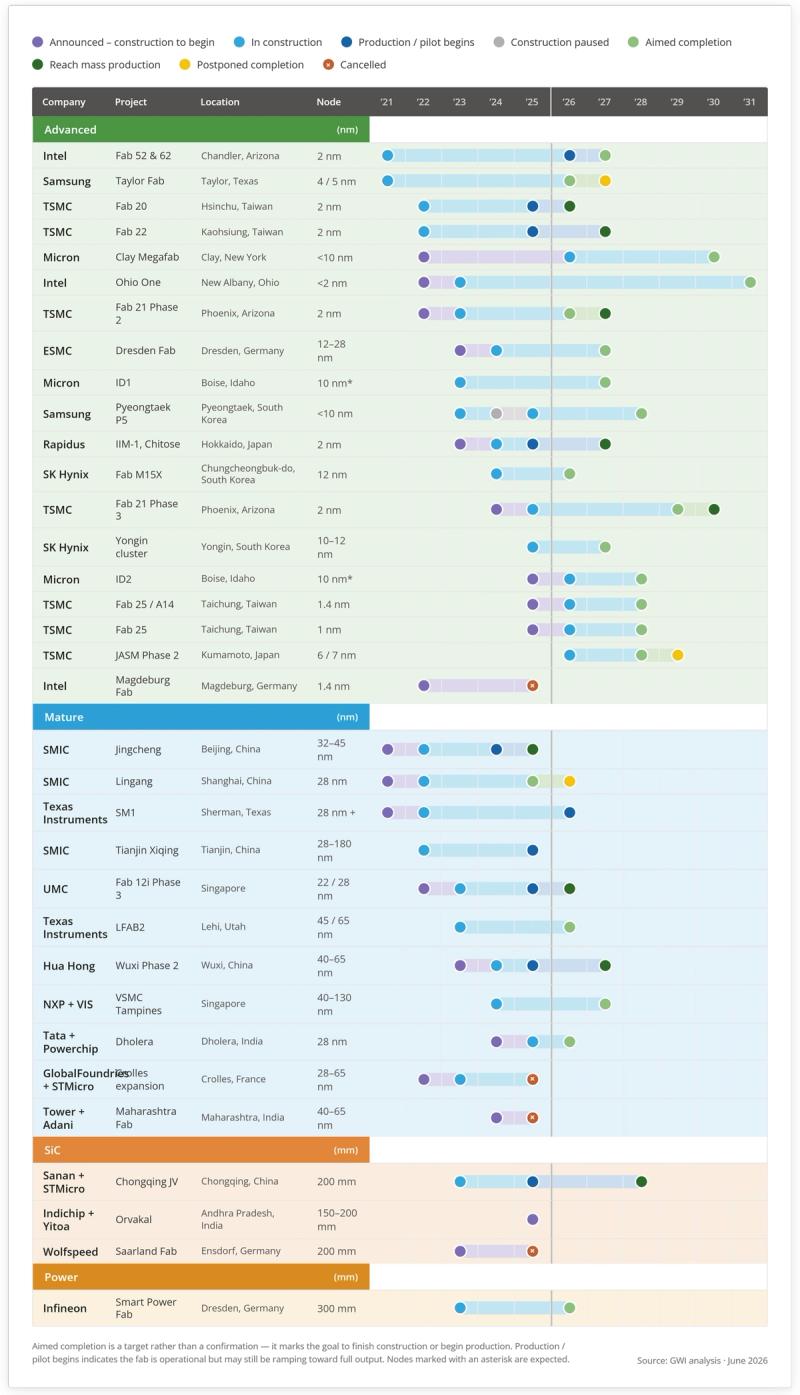
This chart presents an update on the timelines of major fab projects. See the 2025 version here.
Since the 2025 edition, several major fab projects have moved in opposite directions. AI-driven demand has pulled forward some advanced logic, HBM and power semiconductor capacity, while weak foundry, automotive and SiC demand has delayed or cancelled other projects. The updated chart compares the latest public milestones for construction, tool move-in and expected production ramps across major greenfield and expansion projects.
US manufacturing active despite challenges
The US remains one of the most active markets for large greenfield front-end fab projects outside Asia. Samsung’s Taylor fab held a ceremony for the installation of equipment in April 2026 after delays caused by weak foundry demand. The project regained momentum following growing AI-related demand and Samsung’s role in manufacturing Tesla’s AI5 and AI6 chips, while land has also been purchased for additional fabs. TSMC’s Arizona expansion is also advancing. The first fab is already producing chips for major customers, while the second fab is targeting 2027 production and construction has begun on a third facility. TSMC’s purchase of 900 acres additional land in early 2026 points to a longer-term expansion strategy beyond the current buildout. Micron broke ground on its Clay, New York site in early 2026, with production targeted for 2030. However, the company has shifted its near-term focus to Idaho, where Boise ID1 remains on schedule for 2027 production and ID2 is expected to follow in 2028–29, supported by the transfer of federal grant funding.
Asia still leads, but progress is uneven
South Korea remains one of the most active Asian markets, driven by HBM and advanced DRAM demand. SK hynix is advancing both its Yongin cluster and M15X expansion, with Yongin’s first cleanroom expected in 2027 and M15X moving through equipment installation and trial operations ahead of production. Samsung’s Pyeongtaek P5 project has also regained momentum after being paused during the memory downturn. Its restart reflects stronger demand expectations for HBM and advanced DRAM, with production currently expected around 2028.
Taiwan continues to invest heavily in AI-driven capacity, although expansion is largely concentrated within established science parks rather than the large greenfield campuses seen in the US. TSMC is expanding capacity at several sites, including Fab 25 in Taichung, which is being developed for A14 / 1.4nm-class production later in the decade. Singapore has two major fab projects underway. UMC’s Fab 12i expansion was unveiled in 2025 and remains scheduled for production in 2026, while the NXP–VIS VSMC fab is still targeting initial output in 2027.
In China and India, government ambition is driving fab investment announcements, however, not all of these projects have materialised. In China, SMIC’s Lingang project initially moved quickly through land acquisition and early construction, but public updates have since been limited, making its current ramp status difficult to verify.
India is beginning to move from policy ambition toward implementation, but uncertainty around project status remains. The Indichip–Yitoa Micro silicon carbide fab in Andhra Pradesh remains at the planning stage, with no clear public construction update since its 2025 announcement. Tata Electronics’ Dholera fab appears more advanced: although tool installation has not been publicly confirmed, its ASML lithography partnership suggests the project is still progressing toward a late-decade ramp.
Europe’s pipeline narrows
European fab activity has been relatively limited in 2026, with Infineon’s Dresden Smart Power Fab the clearest near-term milestone. The project is running ahead of schedule and is due to open in summer 2026, supported by stronger demand for power semiconductors used in AI data centres, renewable energy, electromobility and industrial applications. However, Intel’s cancellation of Magdeburg, the suspension of the STMicroelectronics–GlobalFoundries Crolles expansion, and Wolfspeed’s decision not to proceed with its Ensdorf SiC fab have weakened Europe’s pipeline. As a result, regional momentum is increasingly concentrated in a smaller number of power and specialty semiconductor projects rather than a broad-based expansion.
UltraFacility 2026 will take place in Phoenix, Arizona, in September under the theme Facility 2.5: AI-Driven Semiconductors.
Find out more and book your place here.Share this insight