Semiconductor in Numbers: Energy Infrastructure Backing US Semiconductor Expansion
Share this insight
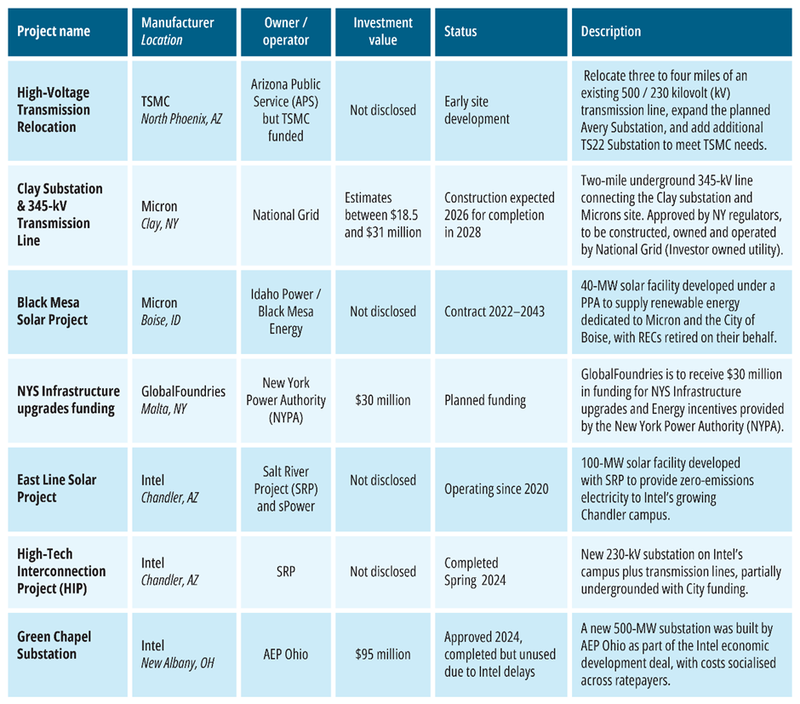
This table shows the scale and structure of energy utility investments backing some of the largest semiconductor projects.
Customer-funded transmission and substation expansion
Major semiconductor manufacturers are funding infrastructure upgrades to power their fabs. TSMC is paying for Arizona Public Service (APS) to make significant grid upgrades to support its North Phoenix plant. APS is relocating 500-kV, 230-kV and 69-kV transmission lines and construction of the new Avery Substation, and planning for additional infrastructure as the semiconductor project expands to as many as six phases.
New York State has approved National Grid to construct a two-mile, 345-kV underground transmission line and expand the Clay substation to supply Micron’s planned fab campus. Construction is expected to begin in 2026, with the line targeted to be operational in 2028. While National Grid will own and operate the infrastructure, it has stated that Micron will cover the majority of costs.
Salt River Project (SRP) developed the High-Tech Interconnection Project (HIP) in partnership with the City of Chandler and Intel, to support Intel’s $20 billion Chandler expansion. The project involved adding a new 230-kV substation and transmission lines linking the site to existing substations, completed in 2024, funded by Intel, with the city approving funding to cover the additional cost of undergrounding portions of the lines.
Utility-facilitated solar capacity additions
SRP also partnered with Intel to supply 100 megawatts of solar power to the Chandler site through the East Line Solar project, operational since 2020. Under a 15-year agreement, SRP provides energy from the solar plant built in Eloy, Arizona by sPower. This is part of SRP’s Sustainable Energy Offering program, which enables large commercial customers to source a portion of their electricity from clean, emission-free resources at competitive rates.
Idaho Power is facilitating development of a new 40-MW solar project in partnership with Micron. The utility has asked the Idaho Public Utilities Commission (IPUC) to approve a power purchase agreement with Black Mesa Energy, which would build, own and operate a dedicated solar facility for Micron’s use. Idaho power would purchase 100% of the power generated, which would flow into the Idaho power grid to serve micron under a 20-year contract which began in 2023.
Cost allocation models: rate base versus customer responsibility
The model used by Idaho power and Micron avoids large upfront costs for Micron, but also doesn’t pass costs on to other ratepayers, so protects other Idaho Power customers from subsidizing Micron’s renewable energy supply. The arrangement comes amid increasing regulatory scrutiny of large power users in Idaho, including proposed House Bill 395, which would require new customers with loads exceeding 10 MW to supply or fund their own incremental electricity needs to ensure infrastructure costs are not shifted onto existing customers.
In contrast, AEP Ohio invested in a large substation for Intel’s Ohio project. As part of an economic development agreement to attract the manufacturer to the region, costs were to be socialised across ratepayers. A 20-year contract was agreed for intel to receive electricity at a reduced rate. Intel’s subsequent project delays have left the utility with an underutilized asset and require contracts to be renegotiated.
Energy provisions within semiconductor subsidy frameworks
GlobalFoundries Malta, NY site doesn’t have any named energy utility projects, however under New York’s Green CHIPS program, the company will enter a sustainability plan with Empire State Development to secure fully renewable electricity for the site, with the potential for onsite solar and battery storage. GlobalFoundries currently receives a discounted 15-megawatt allocation through the New York Power Authority’s ReCharge NY program, an allotment that could increase pending board approval, and is also receiving $30 million in state funding for infrastructure tied to the expansion.
Transmission planning under deregulated market structures
Unlike projects in regulated markets such as Arizona or New York, Samsung and Texas Instruments’ major Texas expansions fall within ERCOT’s competitive, energy-only market, where transmission planning and grid upgrades are handled regionally rather than through customer-specific utility filings. As a result, infrastructure investments tied to their fabs are less likely to be publicly branded as standalone interconnection projects, with power procurement typically structured through market-based contracts and renewable PPAs instead of bespoke utility-led developments.