UltraFacility 2025 Roundtable Summary: Speed or Accuracy? Instrumentation priorities for semiconductor water systems
Share this insight
As semiconductor manufacturing becomes ever more dependent on real‑time data, the role of online instrumentation in process water and wastewater monitoring continues to grow. Yet a familiar challenge remains: when selecting analyzers, should speed or accuracy be the priority?
Micron staff water engineer Joey Zhang brought a hint of Las Vegas to Austin this December with his roundtable at the UltraFacility Conference, 2025, which sought to address this all-important question. His roundtable explored how instrumentation decisions are made in practice, and what truly drives decision-making when trade-offs are unavoidable.
Online analyzers are typically designed to deliver results within tight timeframes to support real‑time control. However, for certain technologies, shorter analysis times can limit accuracy when compared with laboratory methods. Zhang’s roundtable challenged attendees to examine how these compromises affect cost, reliability, and overall system performance across semiconductor facilities by creating their own ‘ideal’ analyzer.
To encourage open discussion, Zhang gamified this challenge. Using a deck of cards, participants were asked to “build” an analyzer: a face card represented analyzer type (either a Silica/Boron, Total Organic Carbon, or Particle analyzer), while red and black number cards represented advantages and disadvantages that could be assigned to either speed or accuracy. Attendees then explained and defended their choices, highlighting how background and operational experience influence priorities.
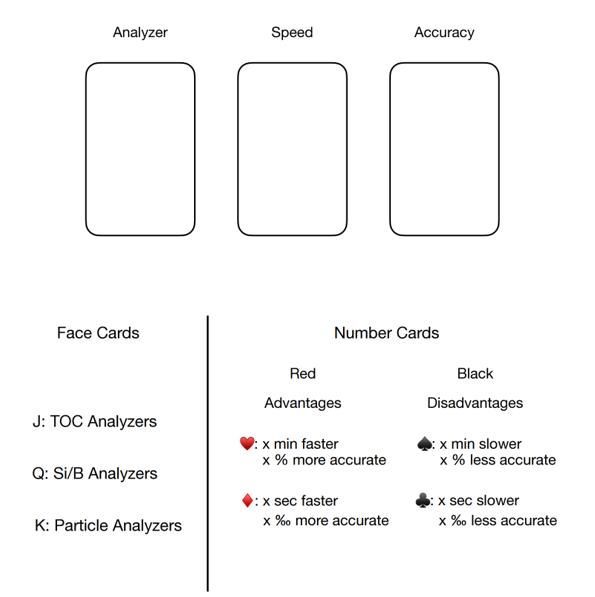
Midway through the exercise, participants were given the opportunity to swap out one card either by bargaining with another attendee or by drawing from the deck and reassess their new configuration. Through this, Zhang highlighted a key operational reality faced by end-users when switching out technologies – blindly switching analyzers can introduce cost and complexity without delivering meaningful improvement, and analyzer performance observed at other facilities may not apply to one’s own site.
The roundtable concluded with a light‑hearted “sales” round, where participants attempted to either sell their analyzer designs or vote for others. This exercise underscored how purchasing decisions are often shaped by trust in vendor relationships or advertised performance, which may not always align with site‑specific requirements.
Deciding factors behind preference for speed or accuracy could be highly related to analyzer type and positioning within the flow sheet – for example, speed could be a priority to have early warning for potential excursions.
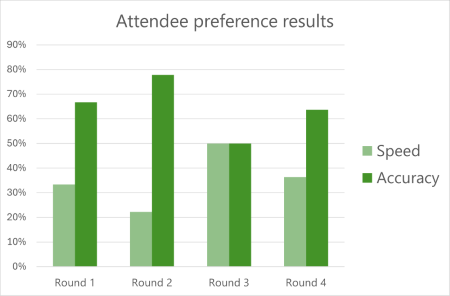
However, at the end of the day, accuracy won across the board as the most important factor, illustrating the market need for reliable, accurate, and timely instrumentation. Zhang’s collected data from the roundtable session at UltraFacility 2025 revealed that in each iteration, attendees prioritized advantages in accuracy over speed.
Online instrumentation delivers speed compared to lab testing, but it has some way to go before manufacturers can put their trust wholly in online, in-line metrology.
This was one of many insightful technical roundtable discussions at the UltraFacility Conference 2025. To find out more about the UltraFacility Conference and help shape the agenda for UltraFacility 2026, visit www.ultrafacility.io/abstracts
Share this insight

Collaborators

Joey Zhang
Staff Water Engineer
Micron
Organizations