Semiconductors in Numbers: The Demand Risk Behind China’s Fab Expansion
Share this insight
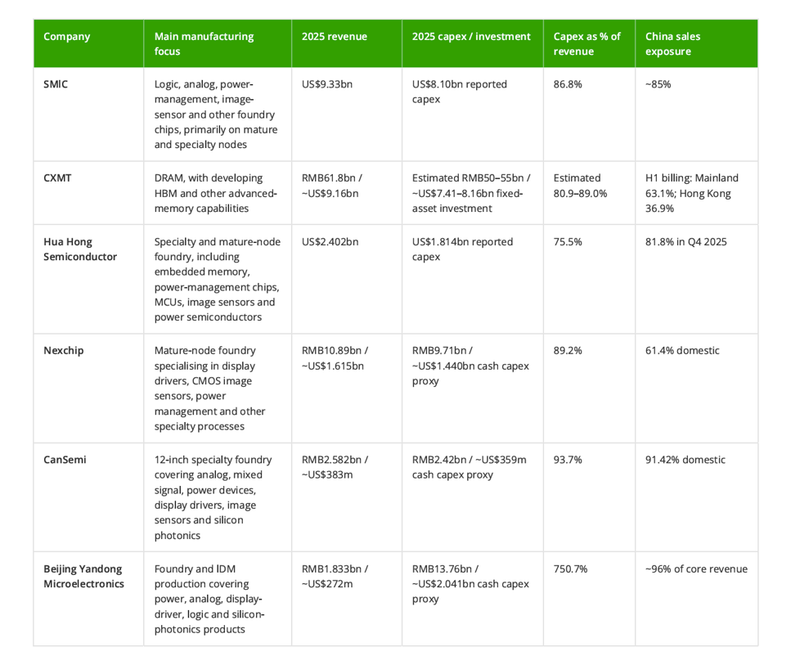
This table presents a selection of major Chinese front-end semiconductor manufacturers. Although disclosure methods differ, the figures show that several are investing at a scale that is very large relative to their current businesses, supported by China’s push to expand domestic chipmaking capacity and reduce reliance on imports.
Import substitution gives the build-out a real demand base
SEMI expects China to remain the world’s largest semiconductor fab spending market in 2026 and to maintain the largest installed capacity volume in both 2026 and 2027. The scale of spending reflects both rapid industry growth and China’s strategic objective of increasing semiconductor self-sufficiency, with new fabs and production lines likely to materially increase the country’s manufacturing capacity. China also remains a major semiconductor importer: in 2025 it imported about 591.7bn integrated circuits worth US$424.3bn. That gives domestic manufacturers a large market to target through import substitution.
The sales mix of Chinese manufacturers already reflects that strategy: across SMIC, Hua Hong, CanSemi, CR Micro and Yandong, roughly 89% of disclosed sales are domestic on average.
China can require more chips and still build too much capacity
China's import dependence is not evenly spread across semiconductor technologies. Constraints on advanced manufacturing equipment and the difficulty of leading-edge production mean much of the new capacity remains concentrated in mature and specialty processes.
China could remain dependent on imported advanced chips while building more mature-node capacity than its domestic market can absorb. Import substitution offers a large initial source of demand, particularly as Chinese electronics companies have strategic as well as commercial reasons to qualify domestic chip manufacturers. But as Chinese chipmakers capture more of the products that are easiest to localise, the remaining substitution opportunity narrows.
State support enables massive expansion, but not necessarily profitability
There is also no guarantee that announced capacity becomes commercially successful capacity. A new fab must establish stable processes, improve yields, qualify products with customers and reach enough utilization to spread depreciation and other fixed costs across a large number of wafers. That challenge is greater for smaller manufacturers attempting expansions that are very large relative to their existing operations.
Yandong shows the scale of that challenge. It generated RMB1.83bn of revenue in 2025, about 14% below 2023, while net profit moved from a RMB452m profit to a RMB408m loss. Yet cash paid for fixed assets, intangible assets and other long-term assets reached RMB13.76bn, or about 751% of annual revenue. Its total assets almost doubled in two years, from RMB18.5bn to RMB37.1bn.
Much of this expansion relates to Beidian Integrated, a Yandong-controlled project company, which is building a new RMB33bn 12-inch fab producing 55nm to 28nm products. The project has planned investment of RMB33bn and will manufacture 55nm to 28nm products. Yandong expects volume production by the end of 2026, followed by a ramp through 2030. At full production, it forecasts annual project revenue of about RMB8.34bn - more than four times Yandong's entire 2025 revenue - and assumes utilisation of 96%.
Yandong’s challenge is therefore not just completing the fab, but ramping it quickly enough to support the scale of investment and finding enough customers to keep a large amount of new 55-28nm capacity loaded.
State support gives manufacturers more room to take this risk. State support is also visible in Yandong’s cash generation: operating cash flow rose 82.1% in 2025 despite weaker revenue and larger losses, an increase the company said mainly reflected higher government subsidies. Its expansion has also been financed through equity contributions, minority investment and borrowing.
State support can weaken the normal brake on overbuilding
That support helps China build capacity faster, but it can also weaken the normal brake on expansion. A private manufacturer facing poor utilization or weak returns would normally cut investment, whereas state support may continue construction for strategic goals relating to supply security, localisation and technological development.
China has already seen the risks. Projects have been suspended, abandoned or restructured after failing to secure enough financing, technology, customers or operating capability.
This risk is greater now as many manufacturers are expanding at the same time, all largely focused on domestic sales. Individually, many of these investments can be justified by China’s import dependence. Collectively, they risk adding too much capacity to the same mature and specialty markets.
If import substitution and semiconductor demand grow fast enough, the new capacity can be absorbed. If they do not, manufacturers may have to compete harder for enough orders to keep fabs running at high utilisation. Stalling demand would put pressure on wafer prices, utilisation and margins, and could eventually push more Chinese semiconductor output into export markets.
Methodology notes
- Capex definitions differ: reported capex, cash paid for long-term assets or estimated fixed-asset investment.
- Geographic disclosures generally refer to the location or registration of the immediate customer or billing entity, not necessarily the final end market. For CXMT: 36.9% of H1 2025 revenue was billed through Hong Kong, but much of this may still relate to Chinese customers and domestic electronics supply chains.
- CXMT geography is H1 2025; Hua Hong geography is Q4 2025.
- YMTC revenue is an external estimate; GTA and Sien do not disclose usable 2025 financials.
- Yandong’s 751% ratio reflects an exceptional fab-construction year.
- Sources: company results, annual reports, exchange filings, IPO prospectuses and project disclosures.
Share this insight