Chip technology has accelerated. Fab construction needs to catch up.
Share this insight
The semiconductor industry is entering another major period of manufacturing expansion, driven increasingly by AI and high-performance computing. But turning investment into operational fab capacity still takes years, creating a growing mismatch between demand and the ability to deliver supply.
According to the SIA, global semiconductor sales were $134.5 billion in June 2026, up 123.6% compared with a year earlier. As manufacturers race to add capacity, construction and commissioning are becoming a major constraint on how quickly that demand can be served.
How long does new fab construction take?
The chart below shows ten completed fab projects with publicly documented construction and production milestones. Delivery times vary substantially, but several of the fastest projects in the sample sit within established Asian semiconductor manufacturing ecosystems.
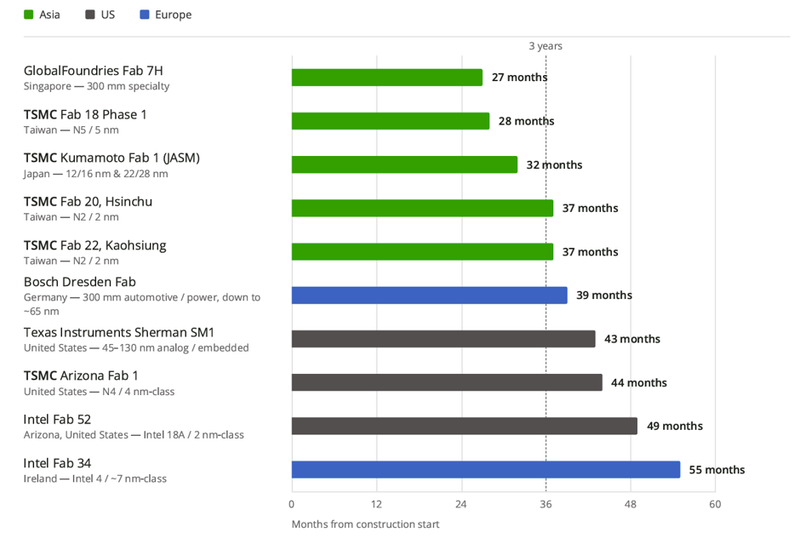
Time measured from construction start or groundbreaking to the stated production milestone. Project scopes and production milestones differ, so the comparison indicates overall delivery time rather than contractor productivity.
GF Fab 7H milestone is limited production; Fab 20 and Fab 22 construction starts are approximate.
The bar for fab construction is rising
TSMC Fab 18 in Taiwan, GlobalFoundries' Singapore expansion and JASM were among the fastest projects in the sample, all within established semiconductor manufacturing ecosystems. Kumamoto could draw on Japan's established industrial base, including engineers with previous electronic-device manufacturing experience. By contrast, TSMC's Arizona Fab 1 was delayed due to shortages of specialist workers during equipment installation.
But even relatively fast delivery may not be fast enough. When TSMC announced Kumamoto Fab 2 in 2024, the new fab was expected to produce technologies up to 6/7 nm. By its 2025 annual report, TSMC said the wider Kumamoto site would also support 3 nm production. Construction of Fab 2 had already begun, but was later paused while the company reassessed the manufacturing equipment and technology requirements for the fab.
A fab can therefore be designed against one demand profile and enter production into another. That raises the bar for construction productivity. Fabs not only need to be delivered faster; they need enough flexibility to absorb changes in manufacturing technology and demand during the project.
That challenge can be amplified in new greenfield locations, where skills, supply chains and operating capabilities may need to be developed alongside the fab itself. But the scale of investment also creates an opportunity to rethink how fabs are designed, constructed and commissioned rather than simply replicate existing delivery models.
Construction productivity is more than building faster
Much of that opportunity starts at the design stage. Early decisions determine how much of a project can later be standardised, repeated or delivered in parallel. Designing with the manufacturing process in mind can reduce later changes, while digital tools can make complex facilities more precise and repeatable.
The same principle extends into construction and commissioning, where thousands of interdependent activities run from facility systems and cleanroom infrastructure through to equipment installation and qualification. Better integration, supported by digital tools, automation and increasingly robotics, can reduce time lost at project interfaces, improve quality and make progress easier to measure. The opportunity is not simply to execute the same process faster, but to change how the work is organised.
Modularisation and offsite fabrication are part of that shift. Moving suitable systems and assemblies into controlled manufacturing environments can reduce congestion on the fab site, make work more repeatable and allow activities to proceed in parallel. Extending that approach into commissioning could reduce the amount of testing and integration that has to occur after systems arrive onsite.
Closing that gap between what manufacturers need and what the supply chain can currently deliver is why construction productivity is a central focus of UltraFacility 2026 and its Construction Innovation Workshop:
Building a $1 Trillion Industry.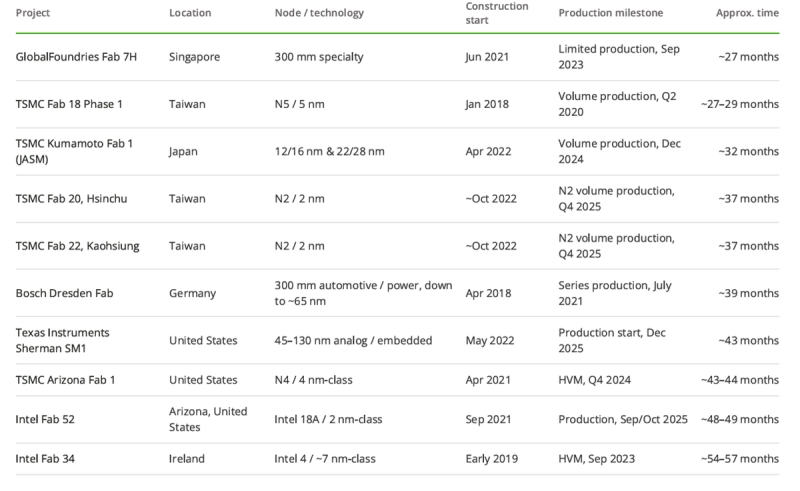
Share this insight